Testing status: this guide is written from manufacturer specifications, published sizing data and general fit principles. It is not a claim of long-term wear testing by our team.
Standing All Day Is a Volume Problem, Not a Cushioning Problem
The advice given to people on their feet for eight to twelve hours usually starts and ends with "get more cushioning". That is half an answer at best.
Two things happen over a long shift. Your feet swell — measurably, by the afternoon — and the muscles that stabilise the foot fatigue. A shoe that was snug at 7am has less room at 4pm, and a foot that is tired spreads more. If the shoe cannot accommodate that change, the last four hours are the ones that hurt.
That is why forefoot room tends to matter more than the thickness of the midsole for people who stand rather than run.
What Actually Changes How the Shift Feels
Room that survives swelling
Pick fit based on the end of the day. If you can only try shoes in the morning, allow for the fact that they will feel tighter later — but do not solve it by buying a longer shoe, which just lets your foot slide.
The surface under you
Concrete is the variable most people ignore. An anti-fatigue mat at a fixed station does more for foot and leg fatigue than upgrading shoes, and the two are not mutually exclusive.
Movement, not stillness
Standing still is harder on the legs than walking. Shifting weight, stepping, and short walks break up the static load. No shoe compensates for eight hours in one position.
Two pairs, alternated
Rotating between two pairs lets each dry out fully and changes the pressure pattern slightly from day to day. It also doubles the life of both.
Birchbury Brenston
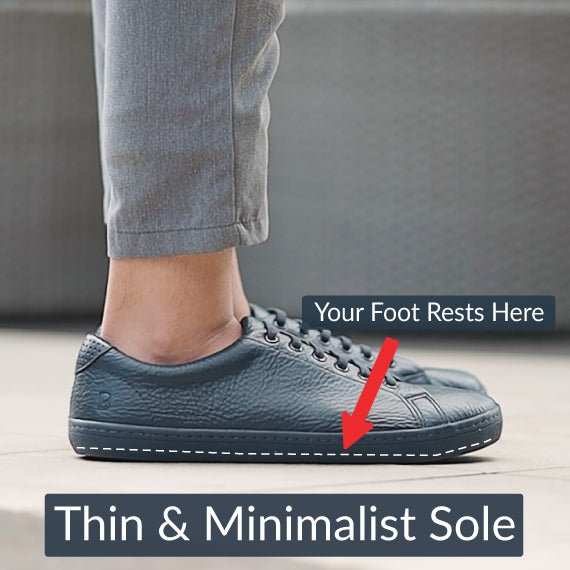
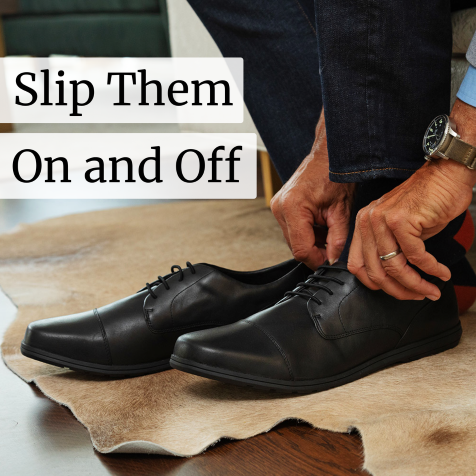
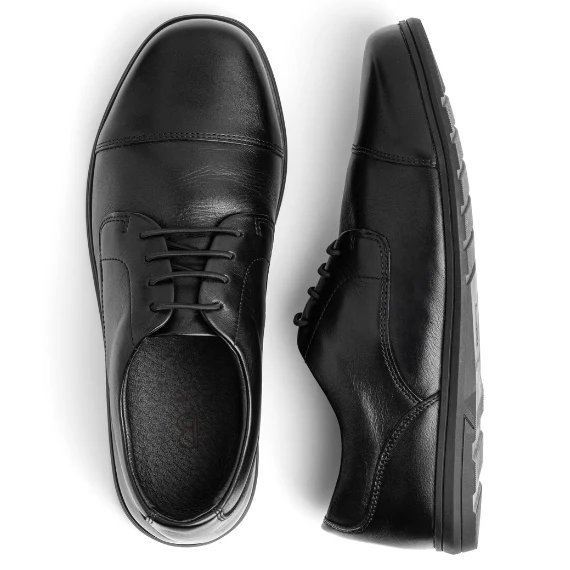
Teaching, healthcare admin, retail management, hospitality front-of-house — jobs that require a proper shoe and eight hours of standing. The Brenston is the model in this range aimed at that overlap: oxford appearance, wide toe box, flat flexible sole.
Matching the Model to the Job
| Work context | Sensible pick | Why |
|---|---|---|
| Office / business dress | Brenston — $180 | Passes a dress code, roomier forefoot than a conventional oxford |
| Retail, workshop, relaxed code | Bramford — $120 | Softest upper, lowest price, easiest to wear all day |
| Cold sites, outdoor work | Carnforth — $197 | Ankle coverage, water-resistant leather options |
| Slip risk (kitchens, wet floors) | Check outsole spec first | Barefoot-style soles are thin; verify traction claims against your workplace requirement |
Note on safety footwear: if your workplace requires certified toe protection or slip-rated soles, that requirement overrides comfort preference. None of these models are safety-rated footwear.
DOING IT SAFELY
Transitioning Without Losing a Week to Sore Calves
The most common failure with flat, flexible shoes is wearing them for a full shift on day one.
Week 1: short exposure
Two to three hours at a time, on a normal day rather than your longest shift. Keep your usual shoes for everything else.
Week 2–3: build up
Half shifts. Watch the calves and the underside of the heel — those are where the loading change shows first.
Week 4+: reassess
If it is going well, take a full shift. If soreness is increasing rather than settling, back off rather than pushing through.
Keep the old pair
Alternating is not failure. It spreads the adaptation over more weeks and gives you a fallback on heavy days.
Fit for the afternoon
Judge room at the point of the day when your feet are largest, not when you first put them on.
Socks are part of the fit
Compression socks, thick work socks and thin dress socks are three different fits in the same shoe.
Stop and get advice if
- Pain in the heel or arch is worse on the first steps in the morning and building week to week
- You develop numbness, tingling or burning that persists after taking the shoes off
- Swelling in one foot or leg is noticeably greater than the other
- Any blister, cut or pressure sore is slow to heal — particularly with diabetes or neuropathy
This is general footwear information, not medical advice. Persistent pain, numbness, swelling or skin changes should be assessed by a qualified clinician — especially for anyone with diabetes, neuropathy or circulation problems.
SHORT VERSION
What Matters, Ranked
- Forefoot room that still works when your feet have swollen
- A mat, if you stand at a fixed station on a hard floor
- Movement and position changes across the shift
- Two pairs alternated rather than one pair worn daily
- A gradual transition if you are moving to a flat, flexible sole
- Certified safety footwear where your workplace requires it — no exceptions for comfort
Frequently Asked Questions
Do I need cushioning or support for standing all day?
It depends on the person and the surface. Heavy cushioning feels good on day one and can feel unstable by week three. What consistently matters is that the shoe fits, does not compress the forefoot, and lets you change position — plus a floor mat if you are standing on concrete.
Are zero-drop shoes a good idea for a job on your feet?
They can be, but not as an overnight switch. Going from a raised heel to a flat sole changes calf and Achilles loading. Introduce them on shorter shifts first, keep your old pair for long days, and increase over several weeks.
Why do my feet hurt more at the end of a shift than at the start?
Feet swell over a working day. A shoe that fits in the morning can be measurably tight by the afternoon. Fit should be judged on the worst part of the day, not the best.
Is it better to sit or stand at work?
Neither extreme. Prolonged standing without movement causes fatigue and pooling; prolonged sitting has its own problems. Alternating position and taking short walks is more useful than the shoe choice itself.
Checking the Brenston?
If your job needs a proper shoe and eight hours of standing, the Brenston is the model aimed at that overlap. Check current stock and sizing.
View Brenston at BirchburyWe may earn a commission if you buy through this link. Price shown was $180 at the time of writing and can change.